Introduction to CO₂-Based Tolling in Europe
The short version: CO₂-based tolling ties what your heavy-duty vehicles pay on motorways to how much carbon they emit. Germany and Austria are already applying it, with differentiated CO₂ emission classes that reward cleaner rigs and—crucially in 2025—special treatment for zero-emission trucks. The rules interact with the Eurovignette Directive, which sets the framework for CO₂ toll implementation, vehicle classification, and how far countries can go on toll exemptions. In H2-2025, Brussels took a big step toward prolonging full waivers for ZEVs; national schemes now need to decide how—and how fast—to react.
Overview of CO₂ Emission Classes
Under the Eurovignette framework, vehicles are grouped into CO₂ emission classes (worst to best). Germany’s Toll Collect assigns a default CO₂ class 1 to older vehicles and uses EU thresholds to sort newer models into better classes; class 5 is reserved for true zero-emission vehicles. Your class is derived from type-approval data (VECTO), first-registration date, and propulsion. Class influences the CO₂ surcharge line on your bill.
Implementation in Germany and Austria
- Germany introduced CO₂ variation to the Lkw-Maut on 1 Dec 2023 (extended to >3.5 t from 1 Jul 2024). The per-km rate now comprises infrastructure, air/noise external costs, and a CO₂ component; zero-emission heavy-duty vehicles are toll-exempt until 31 Dec 2025 under the Federal Trunk Road Toll Act.
- Austria added CO₂ differentiation to the GO-Maut from 1 Jan 2024, with detailed 2025 tariffs by axle and class. ZEVs sit in CO₂ class 5; they pay no CO₂ surcharge, but still pay infrastructure and other external-cost components (rates depend on axles).
Dispatch shorthand: Same principle, different numbers. Germany’s 2025 win is the toll exemptions for ZEVs; Austria’s is lower CO₂ toll rates for class 5, not a full waiver.
Zero-Emission Vehicle Exemptions
Current Exemptions and Their Duration
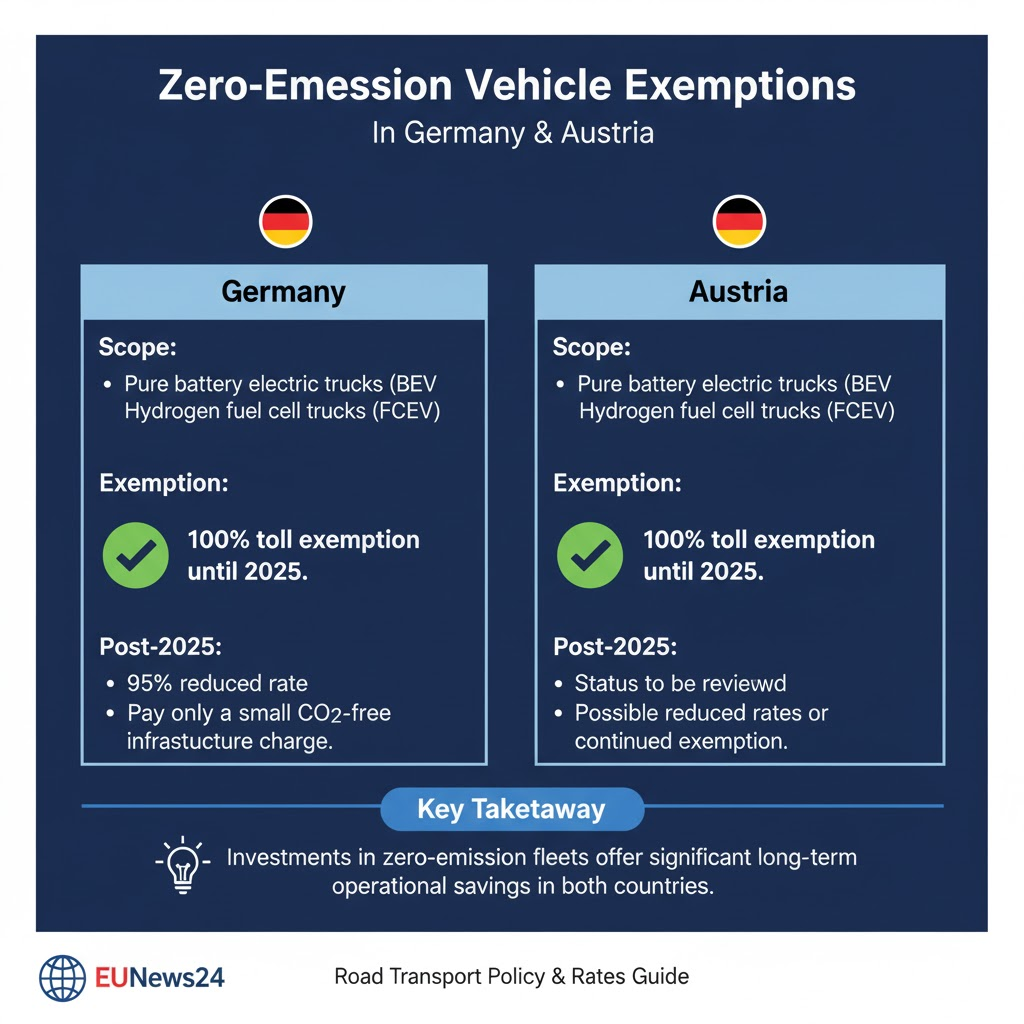
- Germany (2025): All-electric and hydrogen trucks (over 4.25 t) are exempt from the Lkw-Maut through 31 Dec 2025; small ZEV rigids up to 4.25 t enjoy a permanent exemption.
- Austria (2025): No full exemption. CO₂ class 5 (ZEV) pays the infrastructure/noise/air components only; the CO₂ surcharge = €0.0000/km for class 5. Example per-km base lines (ex-VAT) for HGVs: €0.0547 (2 axles), €0.0766 (3 axles), €0.1149 (4+). Section-toll segments (e.g., Brenner, Tauern, Karawanken) publish per-passage figures that are dramatically lower for class 5 than for Euro VI diesels.
Proposed Extensions and Legislative Progress
On 27 June 2025, the European Commission proposed to prolong the option for Member States to fully exempt zero-emission HDVs from tolls until 30 June 2031 (beyond the current 31 Dec 2025 cap). On 7–8 October 2025, the European Parliament backed that extension. The file now awaits Council sign-off (and then national transposition). Until the Council adopts, Germany’s 2026 plan (see below) remains in force.
Anticipated Changes in H2 2025
Potential Policy Shifts
- If/when the Council approves the Eurovignette tweak, Member States may keep full waivers for ZEVs up to mid-2031. That is permissive, not automatic: Berlin or Vienna would need to amend national law to prolong/adjust waivers or discounts. Industry groups (ACEA, IRU, VDA) strongly support the extension to give operators cost certainty.
- Germany’s default from 1 Jan 2026 (as legislated today): ZEVs will pay 25% of the infrastructure component, plus air/noise components; no CO₂ component. In plain terms, a 75% reduction versus a comparable diesel infrastructure share—unless Berlin changes course after the EU law is final.
Infrastructure Developments
- AFIR (the Alternative Fuels Infrastructure Regulation) is now binding: from 2025, ≥350 kW truck chargers must be available every 60 km on TEN-T core and every 100 km on comprehensive corridors; coverage scales up through 2030. This underpins electrified haulage incentives and Europe toll harmonization efforts by making ZEV operations physically feasible.
- Megawatt Charging is leaving pilots: Germany’s HoLa project commissioned first high-performance MCS points in Sep 2025; Austria’s ASFINAG targets truck fast-charging at rest areas and nationwide HDV coverage by 2035. Hydrogen fuel corridors are also expanding (e.g., Düsseldorf’s high-capacity H₂ station, pan-EU corridor consortia).
Impact on the Trucking Industry
Financial Implications for Operators
Germany (baseline if no new law):
- 2025: ZEVs pay €0 (all components waived).
- From 2026: ZEVs pay 25% of infrastructure + air/noise; no CO₂ surcharge. Several official and industry notices confirm the formula; plan fleet budgets accordingly.
Austria (2025):
- Class 5 (ZEV): per-km base applies; CO₂ surcharge line = €0. Example (ex-VAT): €0.0547/0.0766/0.1149 €/km (2/3/4+ axles). Section tolls also show steep gradients—for the Karawanken tunnel, a ZEV 3-axle pays €3.33 per passage vs €13.40 for a Euro VI diesel (class 4).
Cross-border trucking impact: Operators switching between the two systems will see toll rates asymmetry: full exemption in Germany (2025), reduced rates (not zero) in Austria. That adds complexity to fleet management, route planning, and how you structure fuel efficiency and alternate propulsion adoption ROI calculations.
Worked mini-model (illustrative):
- 120,000 km/year long-haul tractor, 3 axles.
- Germany 2025: battery-electric = €0 road user charges; diesel pays full (incl. CO₂ surcharge, which rose overall Maut significantly since Dec 2023).
- Austria 2025: class 5 ZEV ≈ €9,200–€9,500 (mix of corridors; ex-VAT), vs €38,000–€41,000 for Euro VI class 1–4 on identical mileage. (Computed from the published per-km tables; actuals vary by axle mix, routes, and night surcharges.)
- Germany 2025: battery-electric = €0 road user charges; diesel pays full (incl. CO₂ surcharge, which rose overall Maut significantly since Dec 2023).
Budget flag: if the EU’s toll policy changes are finalised, Germany could keep ZEVs fully exempt beyond 2025—but that would require a toll legislation change. Until then, the 2026 25% infrastructure rule is the law of the land.
Strategic Considerations for Fleet Management
- Spec toward better CO₂ classes: Even for diesels, moving from class 1 → 2/3 trims the CO₂ toll rates. OEM guidance and VECTO tweaks (aero, tyres, axle ratio) can lift a tractor one class and shave meaningful opex.
- Data discipline: Keep emission data reporting straight (VIN-linked docs). Use Austria’s CO₂ emission class calculator and Germany’s Toll-Collect portal to cement your vehicle classification updates and avoid overpaying. Compliance auditing and administrative burden reduction go hand-in-hand if you centralise the docs.
- Charging/H₂ readiness: AFIR milestones shape infrastructure development; plan hinterland staging near high-power nodes and verify real-time toll data and charger status in your TMS. Smart tolling systems will increasingly plug into data sharing standards for smoother billing.
- Contracts: Bake logistics cost impacts and toll revenue allocation clauses into tenders. Use “toll policy timeline” language so mid-contract legislative shifts (e.g., a 2031 exemption) have pre-agreed pass-throughs.
- Risk & governance: Maintain an internal “roadworthiness criteria & governance of transport data” checklist so audits don’t stall trucks at border checkpoints.
Tables You Can Share With Clients
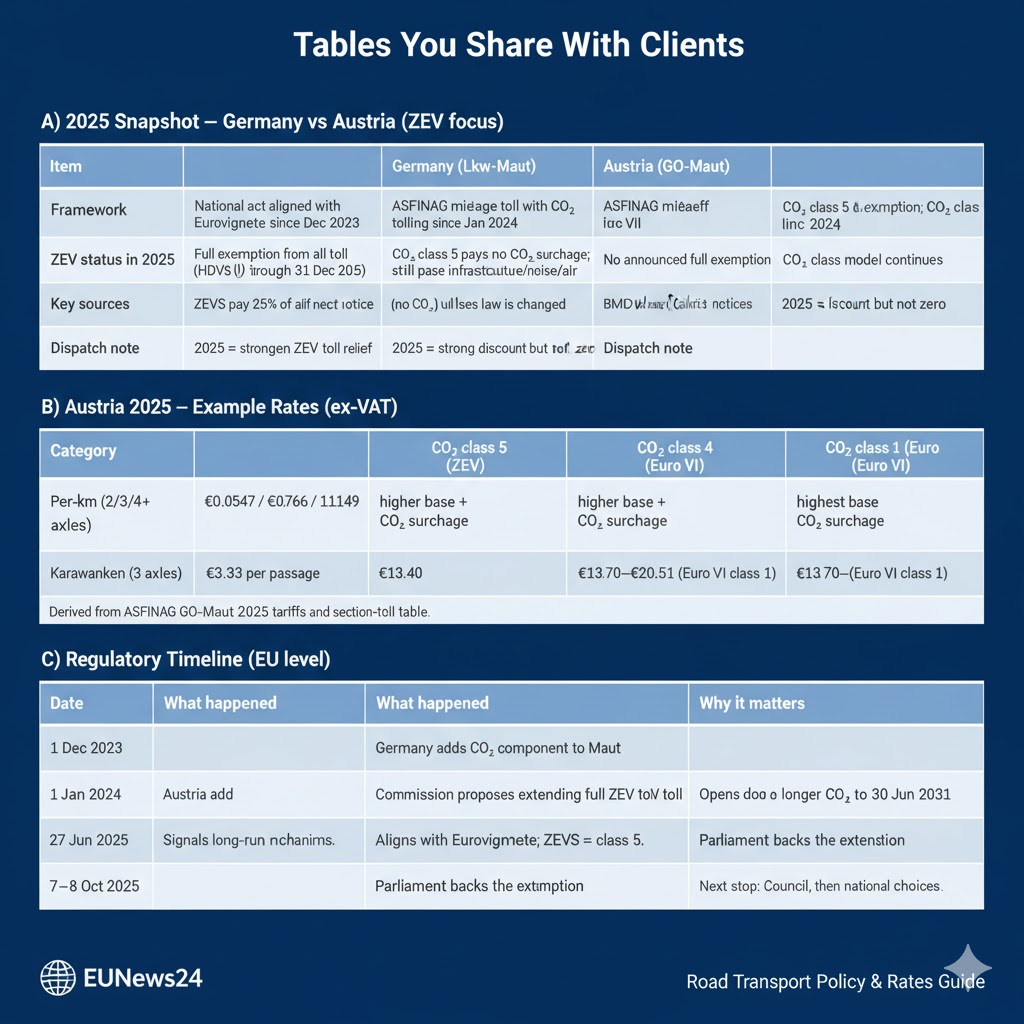
A) 2025 Snapshot — Germany vs Austria (ZEV focus)
| Item | Germany (Lkw-Maut) | Austria (GO-Maut) |
| Framework | National act aligned with Eurovignette Directive; CO₂ component live since Dec 2023 | ASFINAG mileage toll with CO₂ tolling since Jan 2024 |
| ZEV status in 2025 | Full exemption from all toll components (HDVs >4.25 t) through 31 Dec 2025 | CO₂ class 5 pays no CO₂ surcharge; still pays base infrastructure/noise/air |
| 2026 as of today | ZEVs pay 25% of infrastructure + air/noise (no CO₂) unless law is changed | No announced full exemption; CO₂ class model continues |
| Key sources | BMDV scheme; Toll Collect notices | ASFINAG 2025 tariff PDF & info pages |
| Dispatch note | 2025 = strongest European ZEV toll relief | 2025 = strong discount but not zero |
B) Austria 2025 — Example Rates (ex-VAT)
| Category | CO₂ class 5 (ZEV) | CO₂ class 4 (Euro VI) | CO₂ class 1 (Euro VI) |
| Per-km (2/3/4+ axles) | €0.0547 / €0.0766 / €0.1149 | higher base + CO₂ surcharge | highest base + CO₂ surcharge |
| Karawanken tunnel (3 axles) | €3.33 per passage | €13.40 | €13.70–€20.51 (Euro VI class 1) |
Derived from ASFINAG GO-Maut 2025 tariffs and section-toll table.
C) Regulatory Timeline (EU level)
| Date | What happened | Why it matters |
| 1 Dec 2023 | Germany adds CO₂ component to Maut | Signals long-run shift to CO₂ pricing mechanisms. |
| 1 Jan 2024 | Austria adds CO₂ classes to GO-Maut | Aligns with Eurovignette; ZEVs = class 5. |
| 27 Jun 2025 | Commission proposes extending full ZEV toll waivers to 30 Jun 2031 | Opens door to longer CO₂ toll exemptions. |
| 7–8 Oct 2025 | Parliament backs the extension | Next stop: Council; then national choices. |
Practical Playbook (operators’ view)
- Know your class: Verify vehicle classification (CO₂ class, EURO class, axles). In Austria, upload evidence in the SelfCare portal; in Germany, ensure Toll Collect records are correct. Wrong class = wrong bill.
- Model 2026+: In Germany, budget the 25% infrastructure rule from 1 Jan 2026 unless Berlin amends the law to use the EU’s 2031 option. In Austria, class-5 savings are significant already; update route costing.
- Fleet modernization incentives: If your capex clock is ticking, factor fleet modernization incentives (toll savings + AFIR-enabled uptime) into TCO—diesel in class 2/3 also helps if ZEV lead times bite.
- Anti-avoidance & audits: Keep documentation tight to avoid reclassification during compliance auditing (e.g., missing VECTO docs = default to class 1).
- Integrate with LEZ and policy: Link CO₂ tolling with Low Emission Zones, green freight programs, and public transport integration commitments in city deliveries; these policies tend to move together.
- Watch policy drafting progress: EP’s vote is not the finish line. Track legislative progress in Council and national ministries; build a “regulatory transparency” line into customer comms so toll policy changes mid-contract trigger price reviews.
Conclusion
Summary of Key Points
- CO₂-based tolling is now standard in Germany and Austria; your per-km cost varies with CO₂ emissions and axle count.
- Zero-emission vehicles:
- Germany 2025: full toll exemptions through 31 Dec 2025; from 2026, ZEVs pay 25% of infrastructure + air/noise unless Berlin opts to extend the waiver under the EU’s new window.
- Austria 2025: ZEVs (class 5) pay no CO₂ surcharge, but still pay base lines—materially lower than diesel.
- Germany 2025: full toll exemptions through 31 Dec 2025; from 2026, ZEVs pay 25% of infrastructure + air/noise unless Berlin opts to extend the waiver under the EU’s new window.
- H2-2025 EU development: Parliament approved extending the full-exemption option to 2031; Council decision pending. Transport policy is trending toward deeper sustainable transport incentives.
- Infrastructure development via AFIR and early MCS deployments is accelerating electrified haulage incentives and reducing operational risk for ZEV adoption.
Future Outlook
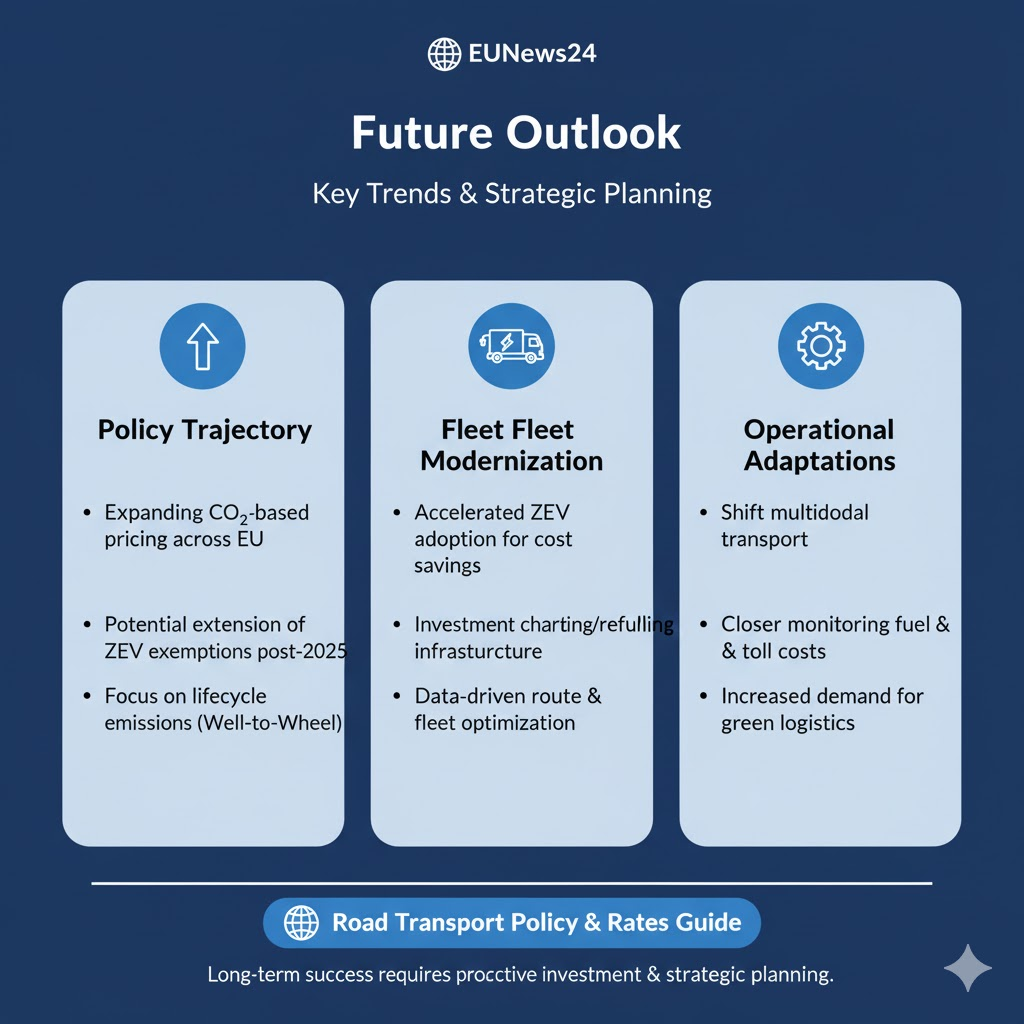
Expect more Europe toll harmonization and data sharing standards across EETS providers, richer real-time toll data in TMS, and firmer compliance rules as authorities sharpen anti-avoidance measures. If Council confirms the 2031 window, the combination of lower CO₂ toll rates, expanding charging/H₂ corridors, and tight emission reduction targets will push the trucking industry into a faster alternate propulsion adoption curve. For operators, the play is simple: lock in your fleet management roadmap now, keep a live logistics risk assessment, and be ready to pivot when the final toll legislation lands.
Sources (primary where possible)
- European Commission (27 Jun 2025): Proposal to extend ZEV toll exemptions to 30 Jun 2031.
- European Parliament (7–8 Oct 2025): Vote backing the extension (awaiting Council).
- Germany (BMDV): HGV toll scheme; ZEV exemption through 31 Dec 2025.
- Toll Collect notices: From 1 Jan 2026, ZEVs pay 25% infrastructure + air/noise (no CO₂).
- Austria (ASFINAG): GO-Maut 2025 per-km tariffs and CO₂ classes (class 5 = ZEV; €0 CO₂ surcharge).
- AFIR / Council press (2023): HDV charging obligations from 2025 (≥350 kW nodes every 60 km on TEN-T core).
- Megawatt & H₂ infrastructure milestones: HoLa (DE) and ASFINAG/EU planning; Düsseldorf high-capacity H₂ station.
No responses yet