Ukraine’s capital fights Russian overnight attacks
 0
0
 0
0
 0
0
0
0
By and
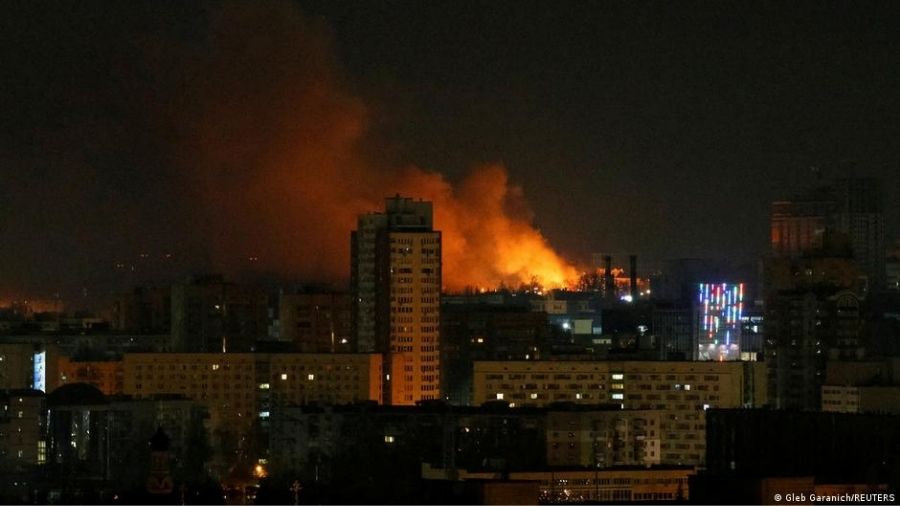
After a night of attacks on cities, including Kyiv, the capital remained under Ukrainian control as the sun rose Saturday morning.
The city was braced for battle heading into the weekends as Russian troops continued to advance and President Volodymyr Zelenskyy had issued a desperate plea for help.
“The fate of Ukraine is being decided now,” Zelenskyy said in an address on social media. “Special attention is on Kyiv — we should not lose the capital. The enemy will use all the possible forces they have to break our resistance. They will be mean and hard. Tonight they will begin a full scale storm.”
Russian troops bore down on the city as the global backlash mounted against the unprovoked attack on a European democracy.
Explosions, air raid sirens and the sound of gunfire filled the air over Kyiv on Friday. Officials in Kyiv urged citizens to take shelter and street fighting was occurring. Explosions were heard overnight, and video showed fighting near the Kyiv Zoo.
In the morning, Zelenskyy posted a video standing in front of what appeared to be a building next to the presidential office in Kyiv. “I’m here,” he said.
Zelenskyy denied what he said were false claims of an evacuation. “We won’t put down [our] weapon, we’ll protect our country,” he said in the video, according to an NBC News translation.
Kyiv Mayor Vitali Klitschko said Saturday said that Russian troops trying to enter the city have been beaten back, but other sabotage and reconnaissance groups were inside.
“The night was difficult, but there are no Russian troops in the capital,” Klitschko said in a Telegram message Saturday morning, according to an NBC News translation. “The enemy is trying to break into the city.”
As of 6 a.m. 35 people had been injured, including two children, he said.
Russian Foreign Minister Sergey Lavrov said Friday that “no strikes are being made on civilian infrastructure,” The Washington Post reported. And the Russian Ministry of Defence said Friday that it was doing all it could to avoid civilian casualties.
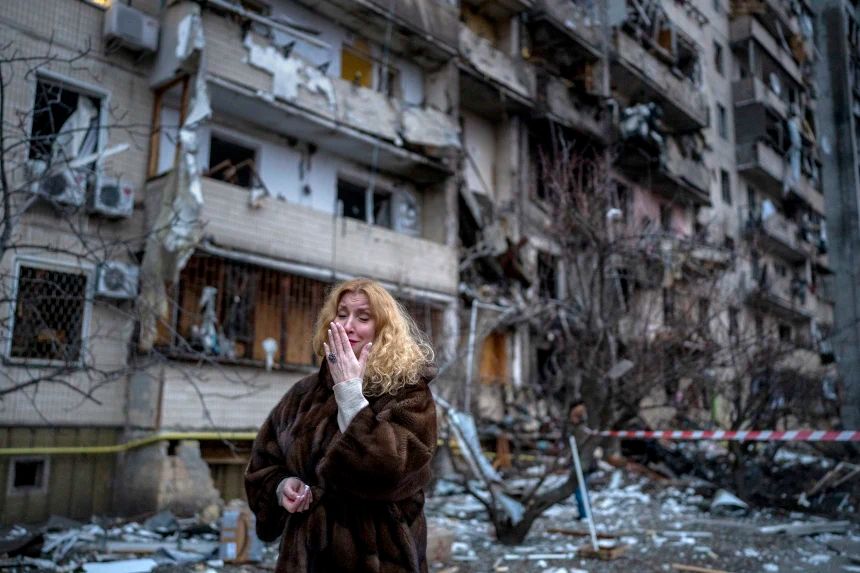
Dmytro Kuleba, Ukraine’s foreign minister, said on Twitter on Saturday morning that Kyiv “survived another night under attacks by Russian ground forces, missiles,” and one hit a residential apartment. NBC News has not independently verified that allegation.
Photos of the building showed heavy damage to several floors with walls and windows blown out and a fire burning inside. The fire was extinguished and the building was being evacuated, according to the State Emergency Service of Ukraine.
Information on injuries was not immediately available early Saturday.
The Ukrainian military said in a Facebook post that Russian troops attacked an army base in Kyiv around midnight on Saturday but were repelled. The military also said there were “heavy battles” in Vasylkiv, a city near the capital. NBC News was not able to independently verify the Ukrainian military’s accounts.
The mayor of Vasylkiv said Russian paratroopers landed but were repulsed. NBC News has not independently verified that claim.
There is fighting on the outskirts of the capital of Kyiv and in the coastal city of Mariupol, but presidential adviser Mykhailo Podoliak said the situation was under control.
“We knew that tonight was going to be a difficult night,” Podoliak said, adding that Russian attempts to harm Ukrainian cities “didn’t work.”
n Friday, the United States and European Union took the rare step of imposing sanctions on a head of state by targeting Russian President Vladimir Putin. The Biden administration also slapped sanctions on Foreign Minister Sergey Lavrov and other members of Russia’s Security Council.
Zelenskyy spoke by phone with President Joe Biden for roughly 40 minutes on Friday, the White House said. Ukraine’s leader tweeted that the two discussed “strengthening sanctions, concrete defense assistance and an anti-war coalition.”
At the United Nations, a U.N. Security Council resolution condemning Russia’s military aggression was vetoed — by Russia. The council voted 11-1 Friday in favor of the resolution, and Russia was the lone vote against it. Three countries abstained.
Putin suggested he might be willing to enter negotiations with Ukraine even as his forces continued their advance across the country. But hours later, the Russian leader urged Ukrainian soldiers to overthrow their government, which he described a “gang of drug addicts and neo-Nazis” — repeating propaganda Russia uses to justify its actions.
On Friday, the United States and European Union took the rare step of imposing sanctions on a head of state by targeting Russian President Vladimir Putin. The Biden administration also slapped sanctions on Foreign Minister Sergey Lavrov and other members of Russia’s Security Council.
Zelenskyy spoke by phone with President Joe Biden for roughly 40 minutes on Friday, the White House said. Ukraine’s leader tweeted that the two discussed “strengthening sanctions, concrete defense assistance and an anti-war coalition.”

Notes: The attack confirmed at Dnipro happened in the area of the city.
Data as of 8:50 a.m. ET, Feb. 26.
Sources: NBC News, State Statistics Service of Ukraine and Natural Earth
At the United Nations, a U.N. Security Council resolution condemning Russia’s military aggression was vetoed — by Russia. The council voted 11-1 Friday in favor of the resolution, and Russia was the lone vote against it. Three countries abstained.
Putin suggested he might be willing to enter negotiations with Ukraine even as his forces continued their advance across the country. But hours later, the Russian leader urged Ukrainian soldiers to overthrow their government, which he described a “gang of drug addicts and neo-Nazis” — repeating propaganda Russia uses to justify its actions.
Inside the embattled capital, Zelenskyy refused to leave and instead made a desperate plea for Western governments to take tougher measures against Moscow.
He has already called up any Ukrainians willing to fight and handed out thousands of guns to civilians. And on Friday, Zelenskyy urged anyone with military experience in Europe to travel to Ukraine and help defend its independence or take to their own streets in protest.
“We are defending our independence, our country,” he said in his latest video message. “It will continue like this. Glory to our defenders, glory to Ukraine.”
The fresh plea from the Ukrainian leader came as the invading Russian troops bore down on Kyiv amid a desperate defense in which hundreds of troops on either side were reportedly killed.
Oksana Markarova, the Ukrainian ambassador to the U.S., said at a news conference Friday that Russia committed what she characterized as war crimes, targeting civilians, taking nearly 100 people hostage at Chernobyl and striking an orphanage with 50 children inside.
“The Russian propaganda machine says that civilians were not targeted. I want to tell you this is not true,” Markarova told reporters.
Kyiv Mayor Vitali Klitschko described Russia’s offensive in stark terms.
“The enemy wants to put the capital on its knees and destroy us,” said Klitschko, a former world heavyweight boxing champion. “The city has gone into a defensive phase. Shots and explosions are ringing out in some neighborhoods. Saboteurs have already entered Kyiv.”
Russia is nonetheless meeting “greater resistance” from the Ukrainians than it might have expected, a senior U.S. defense official said Friday.
“They are fighting for their country,” the official said, referring to Ukrainian troops and freedom fighters.
Also Read: Google Blocks Russian State Media From Earning On Its Platforms
The official said Russian forces are undertaking an amphibious assault to the west of the city of Mariupol, and the United States has indications Russia is placing potentially thousands of naval forces ashore there. American officials assume Russian troops will then attempt to move toward the Donbas region, the official added.
Local officials warned residents in Obolon, a district north of the capital, not to go outside early Friday due to “the approach of active hostilities.” The military said Russian saboteurs — troops disguised in Ukrainian uniforms — were in the streets.
Meanwhile just outside the capital, Russia claimed it had taken control of the strategic Hostomel Airport, which handles heavy cargo flights and would allow Moscow to airlift troops directly to Kyiv. A day earlier, Ukraine’s military said that Russian troops sustained heavy casualties in the fighting there.
NBC News has not verified either side’s reports.
Local officials said that Russia had captured the southern city of Kherson despite its “significant forces” suffering “great loses.”
In the northeastern city of Kharkiv, NBC News correspondent Matt Bradley reported around noon local time Friday that car alarms went off across the city as loud, sustained bombardments drew closer.
“Up until now, we understood Russian troops had set up around the ring road of the city. Now we understand they are moving in,” he said from an underground parking garage filled with journalists and local residents, including children.

Day 2 of Putin’s attack on Ukraine brought airstrikes and ground battles to cities across the country while threatening mass casualties, economic chaos and Europe’s gravest security crisis in decades.
Zelenskyy said Russia had been targeting civilians and residential areas, something that is denied by Moscow, which as recently as Tuesday was saying it would not invade.
Ukraine’s leader said Thursday that he was Russia’s “No. 1 target” — backing up Western intelligence that Russia intends to decapitate his Western-leaning government and possibly replace it with a regime closer to Moscow.
The United Nations said it had confirmed that at least 25 people had been killed across Ukraine but acknowledged that these were likely underestimates, estimating up to 4 million could flee if the fighting escalates.
Kuleba, Ukraine’s foreign minister, accused Russia of attacking a Ukrainian kindergarten and orphanage in what he described as “war crimes.” NBC News was unable to verify the allegations.
Karim Khan, a prosecutor at the International Criminal Court, said he was watching the conflict with “increasing concern” and said his office may investigate possible war crimes in the country.
Amnesty International condemned Putin’s offensive and called on Russian troops to “immediately stop carrying out indiscriminate attacks in violation of the laws of war.”
Zelenskyy said in a statement that at least 137 people had been killed and 316 had been injured during the first day of the invasion. Meanwhile, the Ukrainian government said Saturday that Russia had lost as many as 3,000 personnel, more than a dozen aircraft and 102 tanks.
NBC News has not confirmed the numbers of any injuries or deaths on either side.
International condemnation of Russia grew louder on Friday amid reports of civilian casualties.
NATO leaders called the attack “brutal and wholly unprovoked and unjustified,” in a news release which said Russia bore “full responsibility for this conflict” and would “pay a severe price, both economically and politically, for years to come.”
They added that they had drawn up defense plans and “deployed defensive land and air forces in the eastern part of the Alliance, and maritime assets across the NATO area.”
Pope Francis went to the Russian Embassy in Rome to relay his concern over the invasion to Moscow’s ambassador, Vatican spokesman Matteo Bruni said, an unprecedented departure from diplomatic protocol.
In Kazakhstan, a former Soviet republic and one of Russia’s closest allies, the government said it was denying Moscow’s request to send Kazakh troops to join Russian forces in Ukraine. It also said it would not recognize the Luhansk People’s Republic (LNR) and the Donetsk People’s Republic (DNR) — the two Moscow-backed breakaway regions in Ukraine that Putin formally recognized as independent earlier in the week.
Against this backdrop of growing global pressure, there were mixed messages from the Kremlin.
Dmitry Peskov, a Putin spokesman, said Moscow was ready to discuss Ukraine’s earlier offer of talks about realigning the country so it had a “neutral status” between Russia and the West.
Putin held a phone call with Chinese President Xi Jinping on Friday, with the Kremlin claiming in a readout that the Russian leader was ready to send a delegation to Minsk for negotiations with Ukrainian representatives.
But hours later, Putin used a televised meeting of his Security Council to call on the Ukrainian military to “take power into your own hands” because it would be easier for Russia to negotiate with the army, than with Zelenskyy.
Lavrov had earlier suggested that Moscow would only enter talks once Ukraine had laid down its weapons.