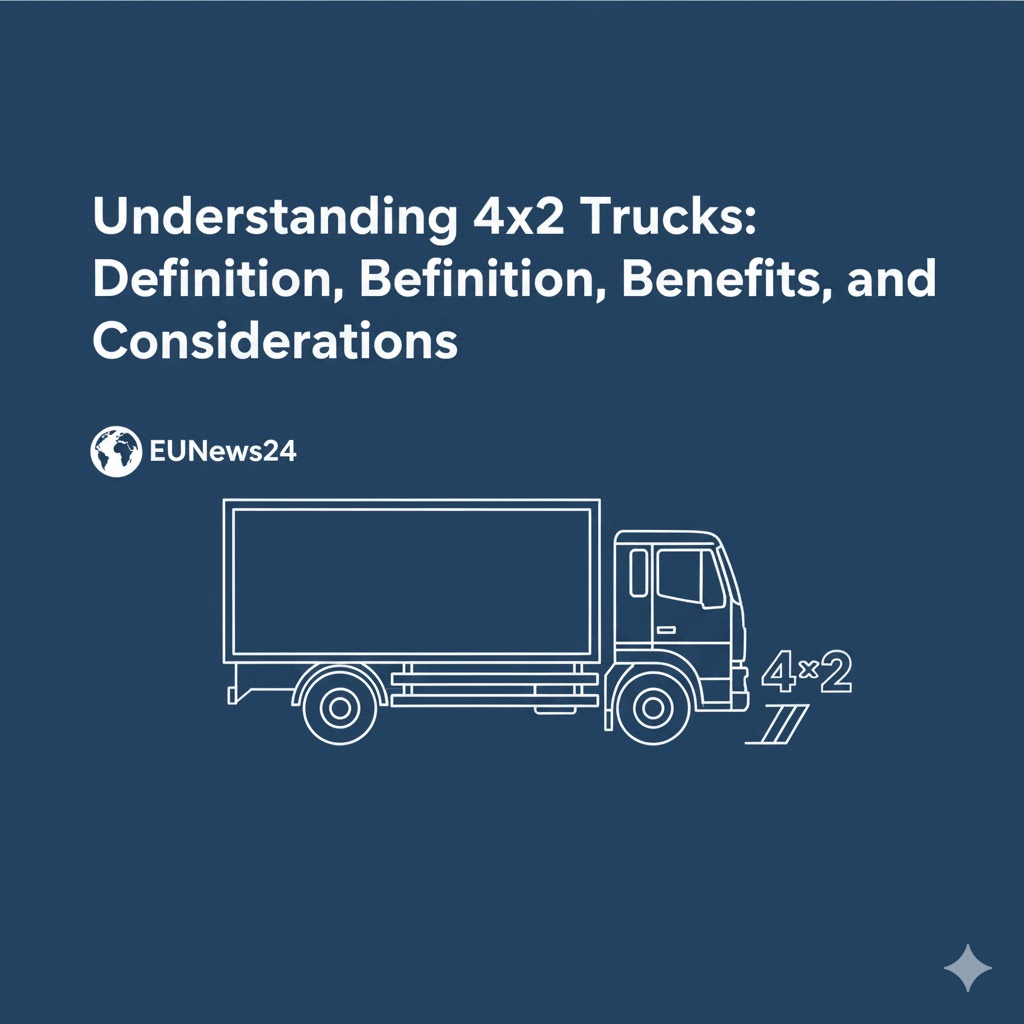
What Does 4×2 Mean?
If you’re comparing drivetrains for a new fleet tractor or a light-duty pickup, you’ll see the term 4×2 trucks everywhere. In plain language, “4×2” describes a vehicle with four wheels (or four wheel positions, counting duals as one) where two wheels are driven—that is, two-wheel drive. In most medium- and heavy-duty applications this means rear-wheel drive; some light vans and cabovers are front-wheel drive, but the 4×2 label simply reflects the drivetrain configuration, not which axle is powered.
Drivetrain Configuration
A 4×2 tractor or straight truck sends torque to a single drive axle. Power flows from the engine through transmission options (manual or AMT), across the axle ratio, and into the differential that turns the drive wheels. Compared with multi-drive layouts, the 4×2 has fewer rotating parts, a simpler suspension setup on the drive axle, and a lighter tare weight—advantages that ripple into fuel efficiency, maintenance costs, and affordability.
Common Applications
- Linehaul and regional haul on paved roads. When traction is predictable, a 4×2 delivers excellent highway handling, stable lane tracking, and low maintenance expenses.
- City delivery/last mile. Short wheelbases and a single drive axle boost maneuverability and ride quality on tight streets.
- Light-duty work trucks. Many pickups and vans use 4×2 for cost and fuel economy, reserving 4×4 only for routes that truly need off-road capability.
EU context: Across European long-haul, the 4×2 tractor is common because axle taxes, tare, and emissions incentives reward lighter axle configurations that still meet gross vehicle weight and payload capacity requirements.
Advantages of 4×2 Trucks
Fuel Efficiency
Fewer driven components mean less parasitic loss. With only one drive axle (and no transfer case), a 4×2 reduces frictional drag and rotating mass, improving vehicle efficiency and real-world fuel economy. On open motorways, the fuel delta over otherwise similar 4x4s can be meaningful, especially as air resistance climbs with speed (drag ∝ speed²) and drag coefficient becomes a bigger factor. If you’re tracking route efficiency metrics, a 4×2 usually wins whenever roads are sealed and grades are moderate.
Lower Maintenance Costs
No front differential, no transfer case, fewer CV joints—less to service and fewer failure points. Over the life of the truck, that translates into lower repair costs, longer maintenance intervals, and simpler vehicle maintenance. Brake jobs and tire rotations are straightforward, and you’ll typically see more even tire wear when the drive axle is set up and aligned correctly.
Affordability
Upfront purchase price favors 4×2. In tight budget constraints, that can be decisive—especially for small fleets balancing cash flow against growth. Lower capex plus lower opex (fuel + maintenance costs) equals an attractive cost comparison against 4×4 when you don’t need the extra traction daily.
Considerations When Choosing Between 4×2 and 4×4
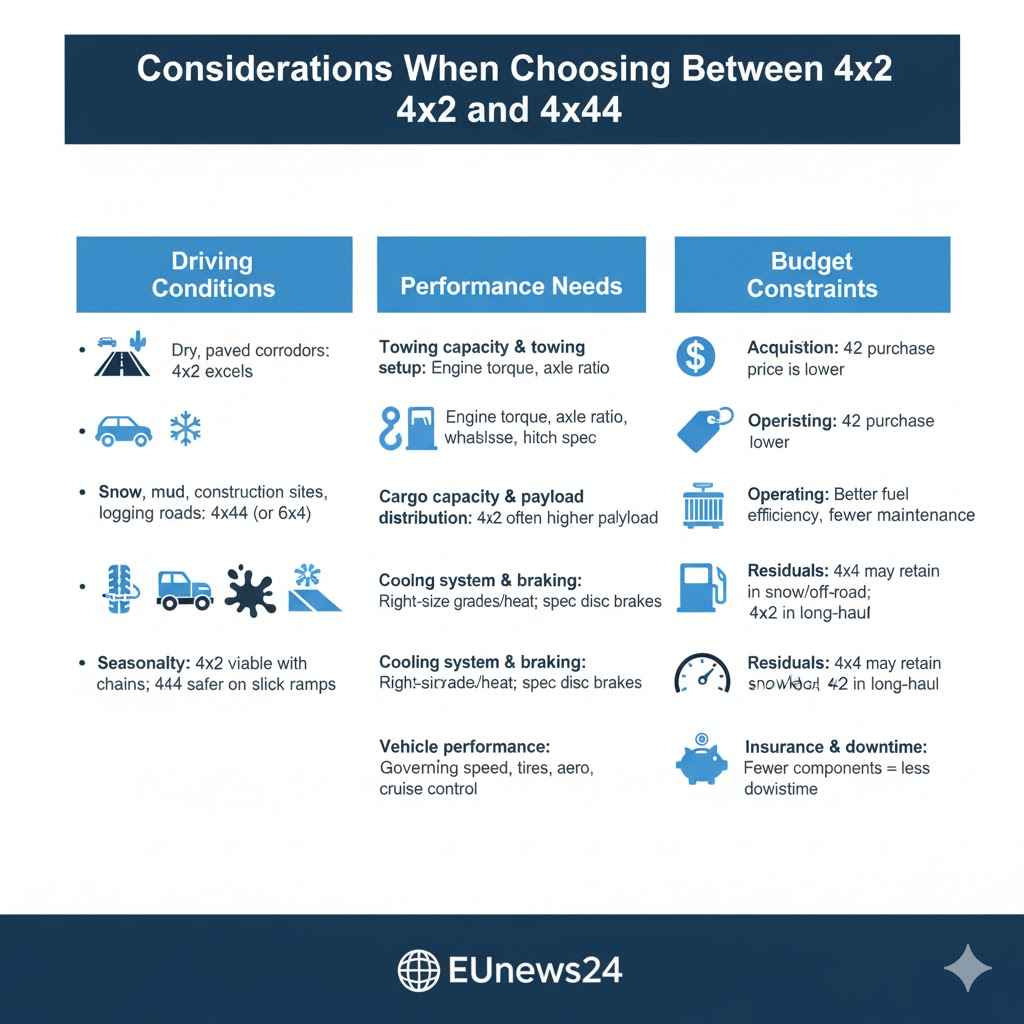
Driving Conditions
This is the big one. Match your vehicle choice to where it actually runs:
- Dry, paved corridors: 4×2 excels in road stability and highway handling.
- Snow, mud, construction sites, logging roads: 4×4 (or 6×4 in heavy-duty) provides crucial off-road performance, launch traction on grades, and better control pulling away from soft shoulders.
- Seasonality: If winter hits hard on your lanes, you can still keep 4x2s viable with proper tires, chains, weight over the drive axle, and conservative dispatching—but if you’re regularly climbing slick ramps with a trailer, 4×4 trucks are safer.
Performance Needs
Think about the job, not the badge.
- Towing capacity & towing setup. Driveline strength, engine torque, axle ratio, wheelbase length, and trailer hitch or fifth-wheel spec matter as much as driven axles. Plenty of 4x2s tow heavy confidently on pavement when spec’d correctly.
- Cargo capacity & payload distribution. The lighter 4×2 often offers higher payload capacity at a given gross vehicle weight. Make sure payload distribution (and suspension) keeps weight legal over each axle and preserves braking performance.
- Cooling system & braking. Heavy grades and hot climates punish trucks. Right-size the cooling system and friction materials; spec disc brakes if your duty cycle calls for repeated high-energy stops.
- Vehicle performance & driving performance. Governing speed, tire compound, aero add-ons, and cruise controls matters more than 4×2 vs 4×4 for most on-road vehicle performance outcomes.
Budget Constraints
Do the math line by line:
- Acquisition: 4×2 purchase price is lower.
- Operating: Better fuel efficiency, fewer parts to service, longer maintenance intervals.
- Residuals: In snow states or off-road sectors, 4×4 may retain value better; in long-haul on pavement, 4×2 retains value well due to demand.
- Insurance & downtime: Fewer components can mean fewer failures and less downtime—quiet wins that don’t always show up in brochure truck comparison tables.
A Practical 4×2 vs 4×4 Truck Comparison (Cheat Sheet)
| Dimension | 4×2 (two-wheel drive) | 4×4 (four-wheel drive) | What it means for you |
| Drivetrain options | Single driven axle; simpler drivetrain configuration | Two driven axles via transfer case | 4×2 is simpler and lighter; 4×4 adds traction & complexity |
| Fuel economy / vehicle efficiency | Usually better (less drag/weight) | Lower (more mass & rotating parts) | If most miles are paved, 4×2 wins on fuel |
| Maintenance expenses | Lower; fewer parts; longer maintenance intervals | Higher; more components to service | 4×4 costs add up over years |
| Affordability | Lower purchase price | Higher purchase price | Budget-friendly vehicle selection |
| Towing capacity | Strong on pavement with right axle ratio & engine torque | Better launch/traction on low-μ surfaces | Decide by job and route, not the badge |
| Off-road capability | Limited | High off-road capability/off-road performance | If you routinely leave pavement, 4×4 earns its keep |
| Ride quality & road stability | Often smoother & more predictable on-road | Can feel busier/heavier | For long motorway days, 4×2 is less tiring |
| Braking performance | Comparable when equally spec’d | Comparable when equally spec’d | Tires, weight, and hardware dominate outcomes |
| Truck ergonomics | N/A to driveline; spec cab for comfort | N/A to driveline; spec cab for comfort | Don’t ignore the humans in the seat |
How Spec Choices Shape a 4×2’s Capabilities
Even within 4×2, choices matter. Here’s what actually moves the needle in a vehicle comparison of two otherwise similar trucks:
- Axle ratio: Shorter (numerically higher) ratios improve launch and hill performance; taller ratios reduce rpm at cruise, boosting fuel economy.
- Wheelbase length: Longer wheelbases add stability for trailers and high bodies; shorter wheelbases turn tighter in cities.
- Fuel type differences: Diesel delivers low-rpm engine torque for towing and long range; gasoline trades torque for lower upfront cost; alternative fuels may change tare and cooling needs.
- Transmission options: AMTs keep the engine in its sweet spot, protecting clutches and improving driving performance and economy.
- Tires & suspension setup: Highway rib tires and tuned shocks transform stability and ride quality; spec steer axle capacity for body upfits that shift weight forward.
- Aero: Fairings and air dams reduce air resistance and drag coefficient—quiet mpg wins on any 4×2 linehaul tractor.
Decision Framework: When 4×2 Is the Smart Play (and When It Isn’t)
Choose 4×2 if…
- Your lanes are primarily paved and moderate in grade.
- You want the best fuel efficiency and lowest maintenance costs over high annual mileage.
- You need every kilo of payload capacity you can legally carry at a given gross vehicle weight.
- Your crews rarely leave asphalt and don’t need off-road capability daily.
Choose 4×4 if…
- You routinely launch on gravel, mud, or snow, or you back trailers into job sites off pavement.
- Winters are severe and chains aren’t always practical.
- Your performance needs include aggressive site access where traction equals safety.
Real-World Scenarios (Miles, Money, Safety)
- Long-haul dry van, EU motorways
- 4×2 tractor + aero kit + tall axle ratio.
- Results: lower fuel burn, less tare, stable highway handling.
- Safety: braking and stability depend on tires and weight, not on driven axles.
- 4×2 tractor + aero kit + tall axle ratio.
- Regional construction supplier
- Mostly paved, but last 2 km on dirt lot.
- If a 4×2 gets stuck monthly, the lost deliveries may dwarf the fuel savings—here 4×4 repays in uptime.
- Mostly paved, but last 2 km on dirt lot.
- Light-duty service pickup in a coastal city
- 4×2 with correct trailer hitch and towing setup handles generators and small trailers; better affordability and repair costs profile.
- 4×2 with correct trailer hitch and towing setup handles generators and small trailers; better affordability and repair costs profile.
Maintenance & Safety Notes Specific to 4×2
- Brake maintenance is still king. Your braking performance hinges on pad/shoe health, rotor/drum condition, fluid (hydraulic) or air pressure integrity (pneumatic), and alignment.
- Vehicle maintenance tips: Rotate tires, watch rear-axle seals, and align for even tire wear. A clean undercarriage prevents corrosion on brake lines and keeps the cooling system breathing in heat.
- Driving tips: On wet ramps or oily yards, gentle throttle and planned lines make 4×2 feel almost like limited-slip AWD. Defensive inputs preserve traction and driving safety.
Budgeting the Choice (Five-Line Model)
- Capex delta: 4×4 costs more at purchase.
- Opex delta: 4×2 typically saves on fuel and parts; log it as cents per mile.
- Uptime delta: 4×4 reduces “stuck” events off-pavement; 4×2 reduces shop time on driveline components.
- Resale: Market-dependent—price the exit.
- Risk: For safety-critical site access, traction is a risk control, not a luxury.
Two Quick Tables You Can Share with Stakeholders
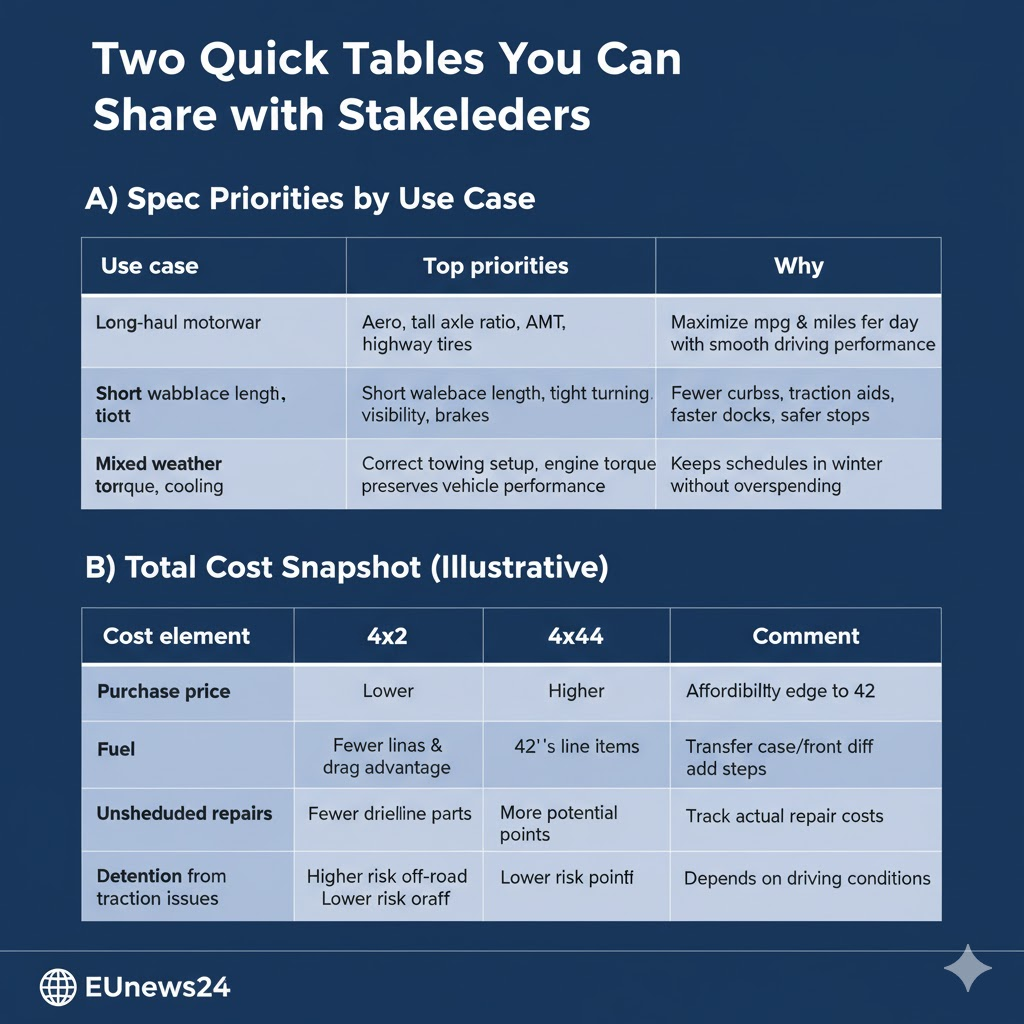
A) Spec Priorities by Use Case
| Use case | Top priorities | Why |
| Long-haul motorway | Aero, tall axle ratio, AMT, highway tires | Maximize mpg & miles per day with smooth driving performance |
| City delivery | Short wheelbase length, tight turning, visibility, brakes | Fewer curbs struck, faster docks, safer stops |
| Mixed weather | Tires/chains, traction aids, retarder/brake spec | Keeps schedules in winter without overspending |
| Occasional towing | Correct towing setup, engine torque, cooling | Prevents overheating, preserves vehicle performance |
B) Total Cost Snapshot (Illustrative)
| Cost element | 4×2 | 4×4 | Comment |
| Purchase price | Lower | Higher | Affordability edge to 4×2 |
| Fuel | Lower | Higher | 4×2’s mass & drag advantage |
| Scheduled service | Fewer line items | More line items | Transfer case/front diff add steps |
| Unscheduled repairs | Fewer driveline parts | More potential points | Track actual repair costs |
| Detention from traction issues | Higher risk off-road | Lower risk off-road | Depends on driving conditions |
Road Manners: What Drivers Actually Feel
Operators often report that 4×2 tractors feel lighter on their feet, with calmer road stability and less driveline lash on smooth tarmac. That, plus well-tuned seats and controls, equals better truck ergonomics over 10-hour days. On slick docks or crowned gravel yards, though, the same 4×2 may struggle to pull away with a heavy cargo capacity load—plan your driving schedule and staging accordingly.
Conclusion
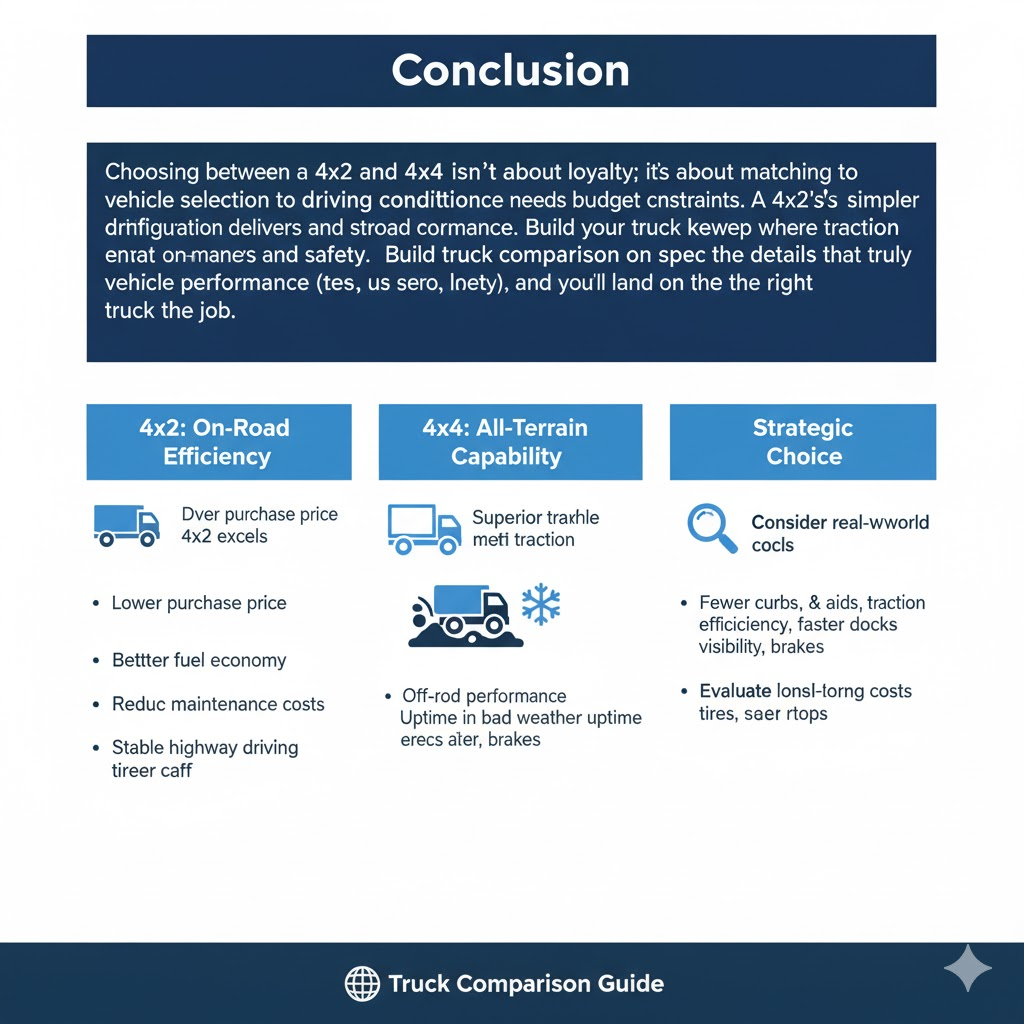
Choosing between a 4×2 and 4×4 isn’t about loyalty; it’s about matching vehicle selection to driving conditions, performance needs, and budget constraints. A 4×2’s simpler drivetrain configuration delivers standout fuel efficiency, lower maintenance costs, and strong on-road manners. A 4×4 earns its keep where traction equals uptime and safety. Build your truck comparison on real duty cycles, spec the details that truly govern vehicle performance (tires, brakes, aero, ratios), and you’ll land on the right truck for the job.
FAQ
Q: Are 4×2 trucks always rear-wheel drive?
Mostly in medium- and heavy-duty. In light commercial, some 4×2 vans are front-wheel drive; in heavier applications, rear-wheel drive is the norm.
Q: Can a 4×2 tow as much as a 4×4?
On pavement, yes—if you match engine torque, axle ratio, towing setup, and cooling. Off-pavement launch traction favors 4×4.
Q: What’s the biggest hidden advantage of 4×2?
Lower weight and simpler parts, which compound into better fuel economy, longer maintenance intervals, and fewer driveline surprises.
Q: Does 4×4 stop better?
Stopping is about tires, brakes, weight, and balance. With equal spec and payload distribution, braking performance is similar.
Q: When would you not choose 4×2?
If your routes routinely involve snow, mud, steep site exits, or loose surfaces where off-road capability is a daily safety requirement.
Q: How do wheelbase and aero affect a 4×2?
Wheelbase length influences stability and turning; aero trims air resistance and drag coefficient, improving economy at cruise.
Q: What about long-term ownership?
Track maintenance expenses and repair costs in your TCO. Many fleets find 4x2s deliver the best ROI on paved corridors with predictable weather.
No responses yet