Introduction to Truck Stopping Distances
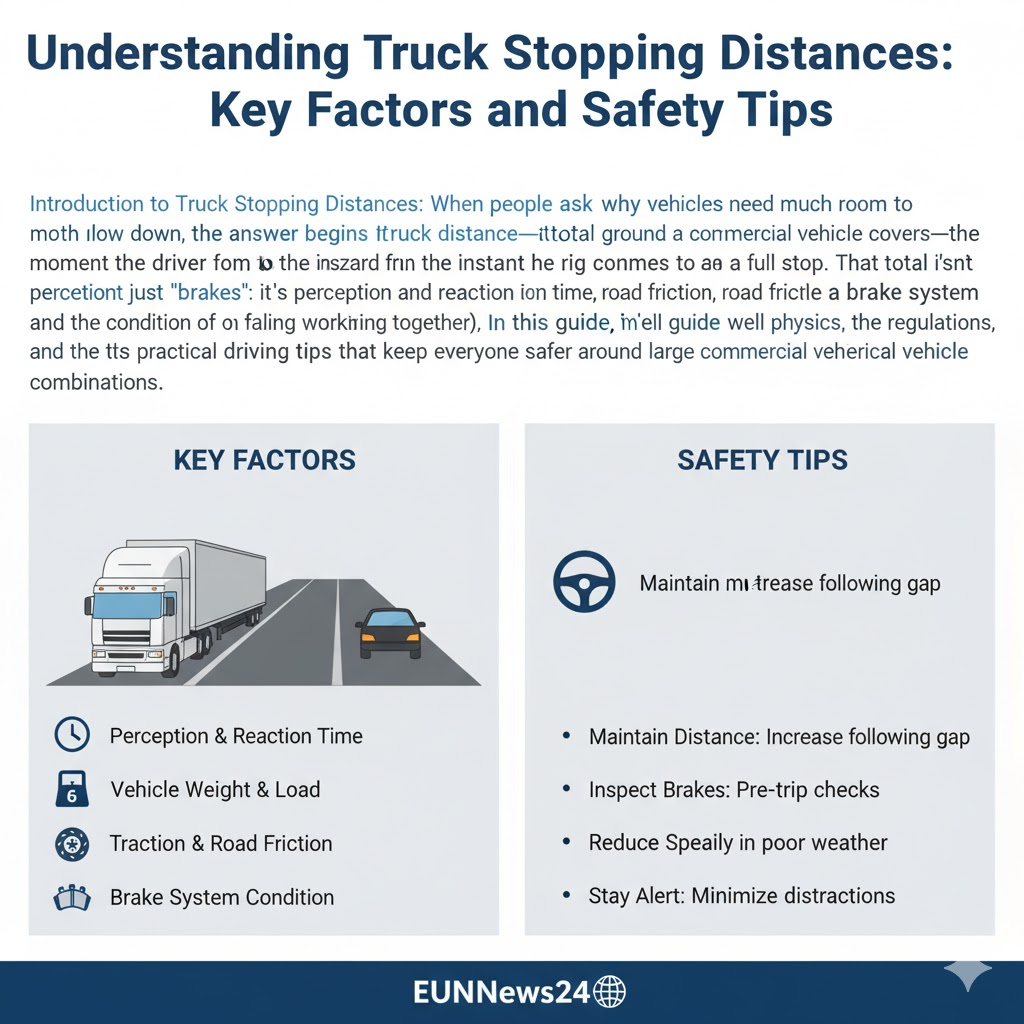
When people ask why heavy vehicles need so much room to slow down, the answer begins with truck stopping distance—the total ground a commercial vehicle covers from the moment a driver perceives a hazard to the instant the rig comes to a full stop. That total isn’t just “brakes”: it’s perception and reaction time, traction, vehicle weight and load, road friction, and the condition of the brake system working together (or failing together). In this guide, we’ll unpack the physics, the regulations, and the practical driving tips that keep everyone safer around large commercial vehicle combinations.
Key takeaway (for busy readers)
Stopping distance = reaction distance (you seeing + deciding) + braking distance (tires and brakes doing the physics). Speed squares the problem, weather cuts tire grip, and poor vehicle maintenance turns a routine stop into an emergency.
Introduction to Truck Stopping Distances
Professional truck drivers run with more mass, higher centers of gravity, and longer wheelbases than passenger cars, so stopping distance factors multiply quickly. At highway speeds and freeway speeds, a fully loaded tractor-trailer (near gross vehicle weight) needs hundreds of feet to stop even in ideal conditions; add rain or ice and the numbers balloon. That’s why truck safety measures, truck regulations, and fleet vehicle maintenance tips exist: to keep road safety margins intact during urban driving and on open roads alike.
Key Factors Influencing Stopping Distances
Vehicle Weight and Load
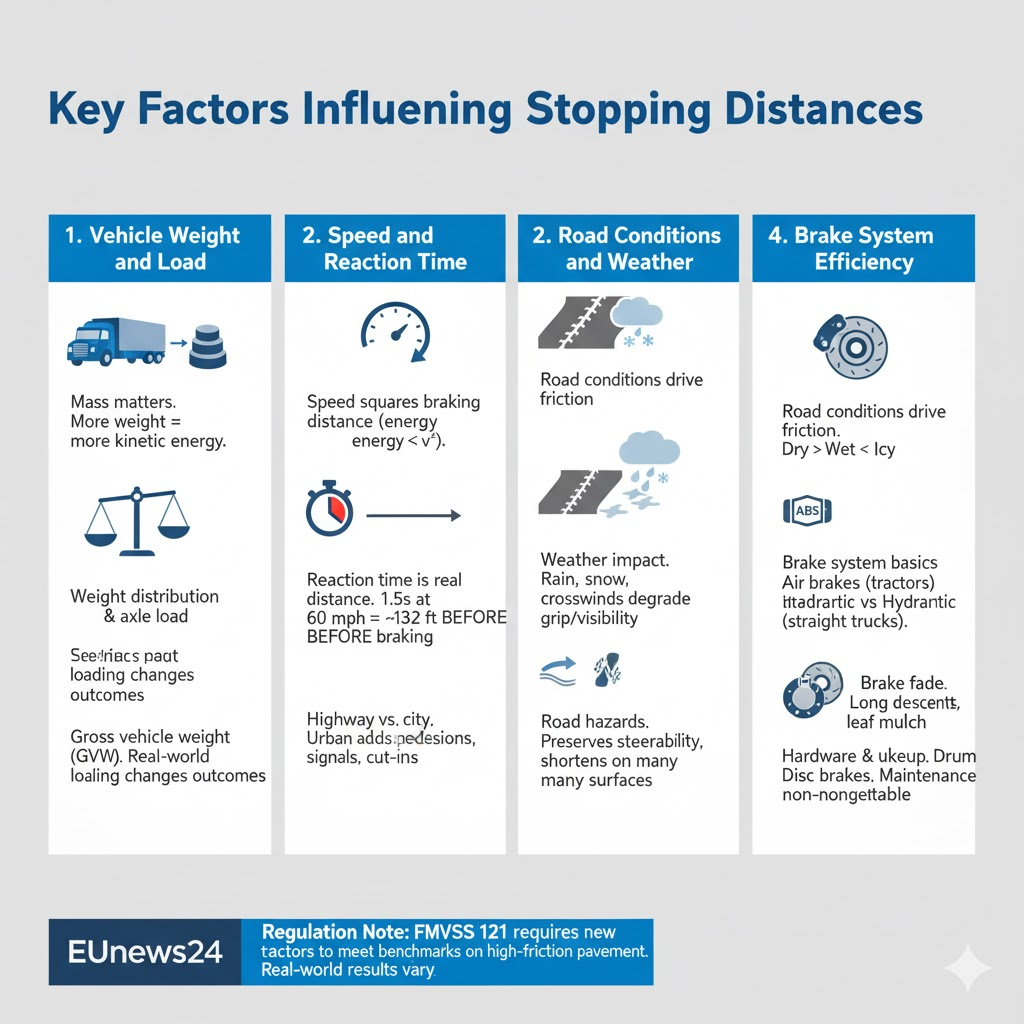
- Mass matters. More vehicle weight means more kinetic energy to shed. At a given speed, an 80,000-lb combination carries vastly more energy than a car.
- Weight distribution & axle load. Poor weight distribution (e.g., heavy tail) reduces steering stability and stretches braking efficiency by overloading some brakes while under-using others; balanced axle load helps each wheel do its share.
- Gross vehicle weight (GVW). Spec sheets publish stopping performance when new, but real-world GVW and trailer spec (drums vs disc brakes) change outcomes.
Speed and Reaction Time
- Speed squares braking distance. Double the speed and the braking distance roughly quadruples (energy ∝ v²).
- Reaction time is real distance. Even at a 1.5-second reaction time, a rig at 60 mph covers ~132 ft before braking begins—pure reaction distance. Fatigue, distraction, or glare can lengthen that, adding tens of meters to truck stopping time.
- Highway vs. city. Highway speeds and freeway speeds deliver predictable flows; urban driving adds pedestrians, signals, and cut-ins that eat buffer space.
Road Conditions and Weather
- Road conditions drive friction. Dry, clean road surfaces yield high grip; wet roads lower it; icy roads can drop effective friction to a fraction of dry pavement.
- Weather impact. Rain, snow, and crosswinds degrade tire grip, visibility, and lane positioning—classic hazardous conditions.
- Road hazards. Potholes, spilled diesel, leaf mulch, and polished intersections can spike stopping distances even on “dry” days.
Brake System Efficiency
- Brake system basics. Tractors typically use air brake systems; some straight trucks and vocational units may run hydraulic brakes. Either way, system health determines braking efficiency.
- ABS effectiveness. Anti-lock control helps keep wheels from locking, preserving steerability and shortening stops on many surfaces; ABS cannot make up for bald tires or overheated brakes.
- Brake fade. Long descents overheat linings and drums/rotors, causing brake fade and longer stops.
- Hardware & upkeep. Drum brakes can be robust but heat-sensitive; disc brakes generally resist fade and recover faster. Brake maintenance—checking brake pad wear, rotor wear, slack adjusters, and air pressure (for air systems)—is non-negotiable. A lit brake warning light is an immediate out-of-service conversation, not a “later” task.
Regulation note (scope): U.S. stopping distance regulations (FMVSS 121) require most new truck tractors to meet defined stopping-distance benchmarks on high-friction pavement. Your real-world result still depends on tires, loading, and conditions.
Field math you can use (illustrative)
Use this stopping distance calculator logic for quick estimates:
- Reaction distance (ft) ≈ speed (mph) × 1.47 × reaction time (s)
- Braking distance (ft) ≈ [speed (fps)]² / (2 × μ × g), where μ is road friction (dry ~0.55–0.70; wet ~0.35–0.45; ice can be ≤0.10), g ≈ 32.2 ft/s².
Example (illustrative): 60 mph, 1.5 s reaction, dry μ=0.55
- Reaction: 60×1.47×1.5 ≈ 132 ft
- Braking: (88²)/(2×0.55×32.2) ≈ 220–230 ft
- Total ≈ 350–365 ft (a full football field + end zone). On wet μ=0.35, braking alone can exceed 300 ft, pushing total >430 ft.
These are conservative approximations, not certification values; truck spec, tire compound, ABS calibration, and weight distribution move the needle.
Quick Reference Table — Speed vs. Estimated Stopping Distance (Illustrative)
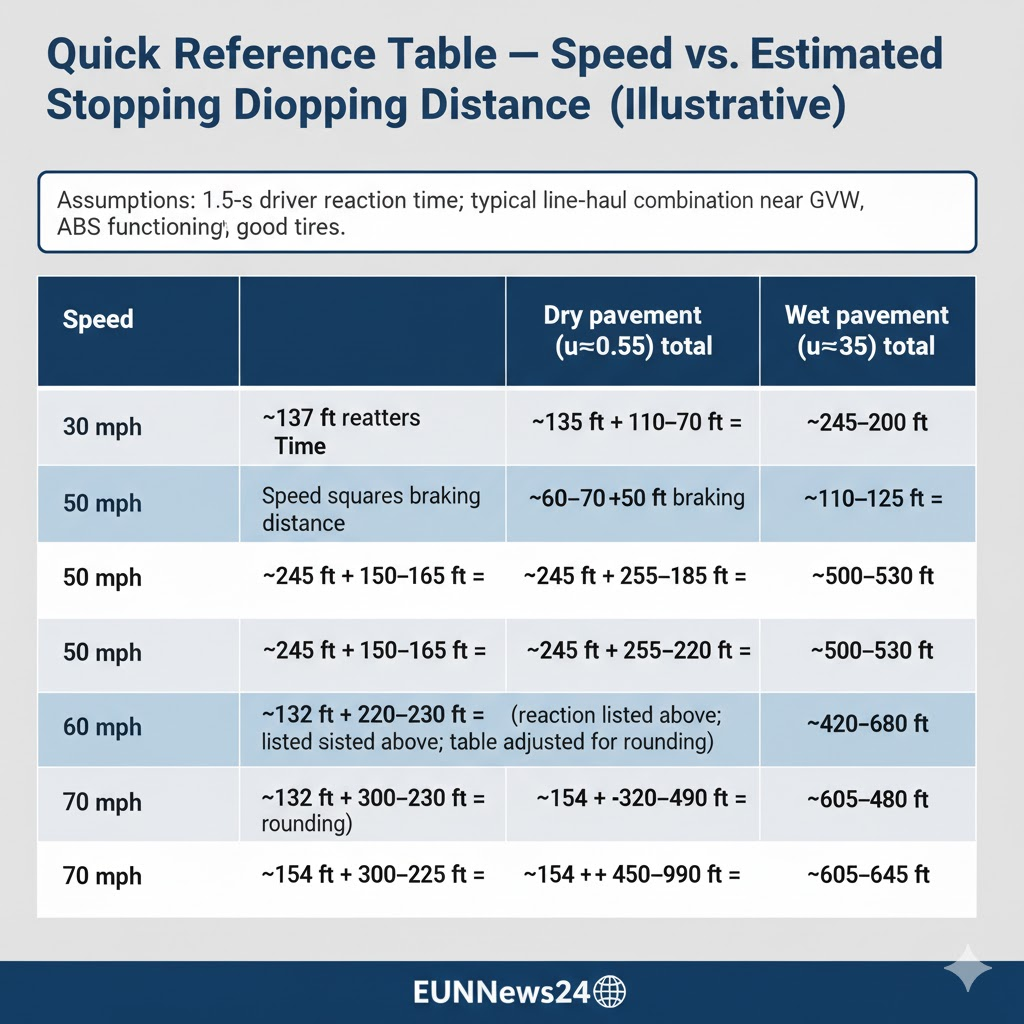
Assumptions: 1.5-s driver reaction time; typical line-haul combination near GVW; ABS functioning; good tires.
| Speed | Dry pavement (μ≈0.55) total | Wet pavement (μ≈0.35) total |
| 30 mph | ~135 ft reaction + ~60–70 ft braking = ~200 ft | ~135 + ~110–125 = ~245–260 ft |
| 50 mph | ~245 ft + ~150–165 ft = ~395–410 ft | ~245 + ~255–285 ft = ~500–530 ft |
| 60 mph | ~132 ft + ~220–230 ft = ~350–365 ft (reaction listed above; table adjusted for rounding) | ~132 + ~320–340 ft = ~450–475 ft |
| 70 mph | ~154 ft + ~300–325 ft = ~455–480 ft | ~154 + ~450–490 ft = ~605–645 ft |
Remember: numbers lengthen with poor tire condition, worn friction material, or downhill grades.
Safety Tips for Sharing the Road with Trucks
Maintaining Safe Following Distances
- Following distance is life insurance. In dry conditions behind a tractor-trailer, leave at least 4–6 seconds; add more for wet roads, darkness, or if you can’t see the truck’s mirrors.
- Don’t “steal space.” Cutting into a truck’s buffer erases the driver’s planned emergency stopping room.
- On freeway speeds, treat the truck’s front bumper as a moving wall—merge only when you can see both headlights in your mirror.
Recognizing and Responding to Hazardous Conditions
- Hazardous conditions = slow down early. Black ice, spray, sun glare, and brake smoke are cues to increase distance.
- If you see a rig fishtail or smell hot linings on a grade, assume brake fade and give it the entire lane and then some.
- Avoid abrupt lane changes near heavy trucks; you’re adding unpredictable road hazards and stealing reaction space.
Importance of Vehicle Maintenance
- For trucks: preventive vehicle maintenance keeps braking efficiency high—regular brake maintenance, lining inspection, drum brakes/ disc brakes service, air-system leak checks and air pressure verification, and tire tread depth checks.
- For all motorists: basic vehicle maintenance tips (tires, wipers, headlights) matter; your car’s ABS and traction control only work if your tires can grip.
Pro move for fleets: train drivers to call out brake warning light events, low system pressure, or pulling under braking, and to report road condition anomalies that spike distances.
Planner’s Corner — Turning science into operations
- Enforce speed discipline on steep descents; engine braking saves linings and prevents brake fade.
- Stage break points before metros; avoid heavy merges where tailgaters erase your margins.
- Keep a seasonal tire plan; winter compounds preserve tire grip and steering stability when temperatures drop.
- Audit CSA/roadside findings tied to brakes; many truck accidents involve out-of-adjustment components or thin linings.
One-page cheat sheet (for drivers and dispatch)
- Know your numbers. At 60 mph you’ll often need 350–450+ ft to stop depending on weather—build that margin into lane changes and merges.
- Feel the fade. If pedal travel increases or stopping lengthens, treat it as a systems issue, not “just heavier today.”
- Use the right gear early. Downshift before grades; engine brakes first, service brakes sparingly.
- Watch the surface. Painted lines, metal plates, and polished intersections cut grip—especially when wet.
- Communicate. Report long downgrades, poor surfaces, and heavy loads that stressed the system—so maintenance and routing can adjust.
Conclusion
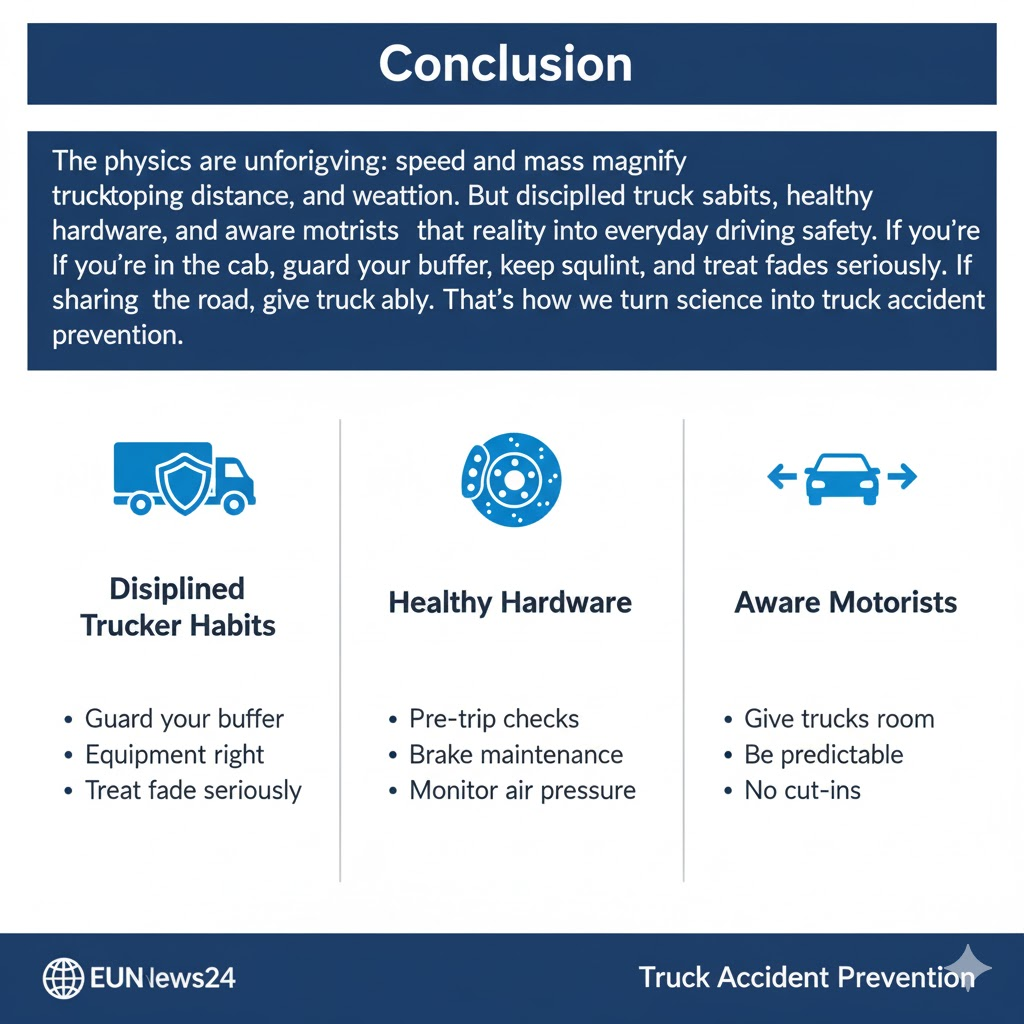
The physics are unforgiving: speed and mass magnify truck stopping distance (second use), and weather cuts friction. But disciplined truck safety habits, healthy hardware, and aware motorists convert that reality into everyday driving safety. If you’re in the cab, guard your buffer, keep your equipment right, and treat fades seriously. If you’re sharing the road, give trucks room and predictability. That’s how we turn science into truck accident prevention.
Bonus: FAQ
Q1: Why do trucks need more room to stop than cars?
Because of higher vehicle weight, taller centers of gravity, and longer brake heat-paths. Energy rises with mass and the square of speed; tires and brakes must convert that energy to heat without losing tire grip or suffering brake fade.
Q2: What’s the difference between reaction and braking distance?
Reaction distance is how far you travel while perceiving and deciding; braking distance is the physics after brake application. Together they make total truck stopping distance (third use).
Q3: How much does weather change things?
A lot. Wet roads and icy roads reduce friction, stretching distances. Add spray, and visibility drops, raising the chance of misjudging gaps.
Q4: Do ABS and disc brakes shorten stops?
ABS effectiveness helps keep wheels rolling (steerability + grip) and can shorten stops on many surfaces. Disc brakes typically resist fade better than drums and recover faster, improving braking efficiency over repeated stops.
Q5: Are there legal stopping distance rules for trucks?
Yes—manufacturers must meet stopping distance regulations under national truck regulations (e.g., FMVSS in the U.S.). Real-world results vary with load, tires, and maintenance.
Q6: How should motorists follow trucks on the motorway?
Increase following distance, avoid cutting in, and pass decisively. Don’t linger beside trailers where drivers may lose sight—your actions affect a truck’s emergency stopping options.
Q7: What maintenance items most impact stopping performance?
Brake pad wear, rotor wear, drum/lining condition, air leaks/low air pressure, ABS faults, and tire condition. Ignoring a brake warning light invites failure.
Q8: Can I estimate my stopping distance on the fly?
Use the simple stopping distance calculator method in this article: reaction (~1.5 s × speed) + braking (depends on friction). Then add margin for weather impact or poor surfaces.
Q9: Does payload placement matter?
Yes. Bad weight distribution overloads axles, undermines steering stability, and lengthens stops, even at the same GVW.
Q10: What are the best “everyday” truck driving tips to reduce risk?
Plan for rest stop planning and fatigue, keep speeds moderate, maintain equipment, and communicate hazards. These truck driving tips cut daily driving risk more than any gadget.
Glossary (fast)
- Stopping distance factors: inputs that change total stopping length (speed, mass, friction, hardware).
- Air brake systems / Hydraulic brakes: common heavy vs. mid/light-duty actuation designs.
- Truck stopping time: elapsed time from perception to rest—grows with speed and weak friction.
- Truck safety tips: practical habits that preserve buffers and equipment.
No responses yet